
Kia ora (hello), and welcome to my first blog and the public launch of a new informational website!
There is currently very little information available on the internet regarding New Zealand’s historical Tapanui ‘Flu epidemic. And what little information there is can not be relied upon because it is frequently inadequate, inaccurate, misleading or – in some cases – just plain wrong.
Correcting history
You may find statements online or in media articles saying a “few people” got sick in the remote rural township of Tapanui, in West Otago, during the early 1980s. Or you may see statements specifying that there were “28 people” who got sick in Tapanui in “1984” – a figure and date that is drawn from the first study of the illness to be published in the New Zealand Medical Journal, which had a sample size of 28 patients (Poore, Snow and Paul, 1984).
And, as of today’s date, if you search Te Ara: The Encyclopedia of New Zealand for an official history of Tapanui ‘Flu, the following two-sentence summary is all you will find…
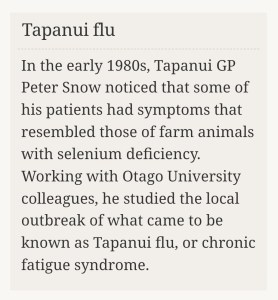
It would be a fine thing if this two-sentence official history was accurate, but it is far from it. The first sentence is totally incorrect, and the second is only partially correct. And there really needed to be at least a third sentence to tell you what happened next.
Somehow Te Ara has managed to make the Tapanui ‘Flu epidemic sound like a storm in a teacup. It has even made it sound like there was really no “epidemic” at all. So let’s start putting this record straight, by quoting the words of Dr Peter Snow himself:

“Some twelve years ago I became aware of a recurring epidemic of chronic fatiguing illness associated with lymphadenopathy, myalgia, muscle weakness, hepatomegaly, splenomegaly, arthralgia, myopericarditis, personality changes, headache, vertigo, and a multitude of odd neurological symptoms such as parathesias, dysethesias, shooting pains, dead arm, dead leg, to name a few. This illness was noted to appear during the late Winter, peak about late Spring to subside during the Summer months (equivalent to late summer-fall in the North temperature zone). I also noted that the condition was common amongst my farmer clients who experienced a type of contagious abortion in their sheep, cattle, deer or pigs.”
– Dr Peter Snow (1992)
Note the words “recurring epidemic” and “contagious abortion”. And also note the clear seasonal pattern that Dr Snow described for the initial stages of this illness – making it entirely consistent with a recurring viral epidemic, possibly of zoonotic origin.
Dr Snow was well aware of the selenium deficiency issue around Tapanui – he had already co-authored two academic papers on this topic before the Tapanui ‘Flu epidemic even got started (Robinson et al, 1978; Robinson et al 1981). Being the only GP in a selenium-deficient area, he would have known the symptoms of selenium deficiency like the back of his hand. But he was quite clear that he was describing an illness that had been triggered by some sort of infectious disease.
And the official diagnosis that people were receiving was not Chronic Fatigue Syndrome, as Te Ara had indicated. It was “Myalgic Encephalomyelitis” (M.E.) – or “the M.E. Syndrome” as the medical profession preferred to call it at the time.
Chronic Fatigue Syndrome (CFS) had not even been invented yet. And, as the USA’s Institute of Medicine (now National Academy of Medicine) has pointed out:
“Historically … the diagnostic criteria for ME have required the presence of specific or different symptoms from those required by the diagnostic criteria for CFS; thus, a diagnosis of CFS is not equivalent to a diagnosis of ME” (Institute of Medicine, 2015).
But there is a much bigger piece of this story that seems to get repeatedly missed. And it seems that only those of us who were already sick at the time are able to remember what happened next.
What appears to have occurred is that the farm animals around Tapanui got sick on a recurring basis, due to an infectious illness. Then the farmers tending to those animals got sick. And then the townsfolk of Tapanui got sick.
And then it spread...
The article which stunned New Zealand
In 2016 I accidentally found a piece of information about Tapanui ‘Flu that I’d never seen before (which I’ll discuss another time) – and it triggered my desire to start researching this epidemic more thoroughly.
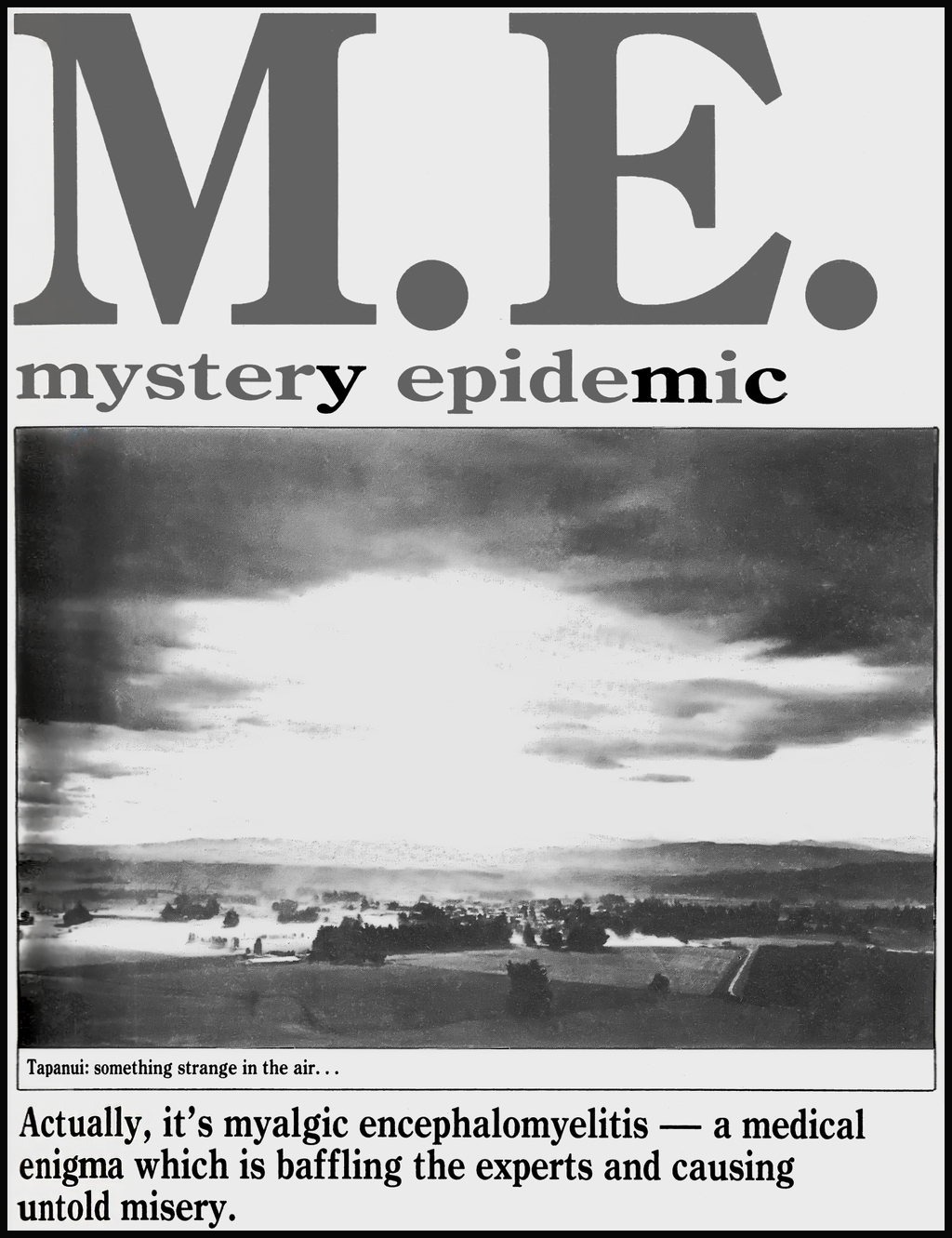
When I started researching the Tapanui ‘Flu epidemic, the first thing I did was to interloan a magazine article that I still vividly remembered reading on the day it was first published – 19th May 1984.
The article was entitled “M.E. Mystery Epidemic” by Jacqueline (Jackie) Steincamp (Steincamp, 1984). It was published in the New Zealand Listener, which was one of the most popular and widely read magazines of the time because – in addition to having great articles – it also had the monopoly on printing the television and radio programming for the entire country. So, if you wanted to know what was on television each night, you needed to buy the New Zealand Listener.
Prior to the Listener article being published, the first news reports from Tapanui had appeared in the Otago Daily Times and on southern regional television around August 1983. But only people living in the lower South Island would have seen this news.
Then, from around November 1983 onwards, those us living in other parts of the country starting hearing about the “mystery illness” plaguing the people of Tapanui, once this story started to appear on national television and in other regional newspapers.
But Tapanui was a very small town, located in the middle-of-nowhere, and a lot of New Zealanders (including myself) had probably never even heard of Tapanui before. So the situation there, while sad for the people who were suffering, didn’t seem to pose any sort of threat to the rest of the country.
That all changed the day that “M.E. Mystery Epidemic” was published in the Listener, breaking the news which stunned New Zealand.
The mystery illness in Tapanui now had a proper name, that was printed in black and white for all to see. It was called Myalgic Encephalomyelitis or M.E., which sounded rather intimidating. And now the illness was no longer contained in the Tapanui area, because the Listener article said there were numerous M.E. cases – possibly even thousands of M.E. cases – occurring in different parts of the country.
Soon after this article was published the terms “Tapanui ‘Flu” and “M.E.” seemed to immediately enter the New Zealand vernacular of the time. Suddenly everyone was talking about “M.E.” – and everyone seemed to know someone who might already have it. If you listened carefully it was possible to overhear conversations about M.E. or Tapanui ‘Flu occurring almost wherever you went – bus stops, coffee shops, street corners… everywhere.
“M.E. Mystery Epidemic” – 40th anniversary digital edition
In 2019 I started making an intermittent series of visits to Archives New Zealand and the National Library of New Zealand, both located in Wellington. I was unable to find a physical copy of New Zealand Listener dated 19th May 1984, and was told that the National Library’s two physical copies both appeared to be missing. I’m in the process of following this up, to see if either copy has ever been found. But for now all I have is a grainy black and white photocopy that is quite hard to read.
So to commemorate the 40th Anniversary of Jacqueline Steincamp’s amazing publication, and to help to preserve it for posterity, I have now placed a fully digitised version of Jackie’s 3000+ word article on my website. This has been done with the kind permission of Jackie’s son, Hugo Steincamp.
The link for the new static web page is below.
“M.E. Mystery Epidemic” – 40th Anniversary Digital Edition
This digital version will hopefully be much easier to read, especially for people with neurological and visual processing issues. And it will also be discoverable by search engines, to ensure the fascinating historical details it contains will become available to a whole new generation of readers – including people with M.E. and CFS, people with Long Covid, medical professionals, researchers, historians and journalists.
For those who would like to see the original article as it appeared in the New Zealand Listener, there is also a downloadable version of the black and white version I obtained in 2016, that can be accessed from a referenced landing page using the following link (with apologies for the poor quality).
“M.E. Mystery Epidemic – Original New Zealand Listener Edition”
Some historical highlights
As you will see when you have had a chance to read Jackie Steincamp’s article, it provides a lot of interesting details, some of which I will summarise below:
- In addition to the numerous M.E. epidemics recorded around the world up until the time this article was published, it seems there had also been previous “time-clusters” of unrecognised M.E. cases in New Zealand. The article indicates there were clusters of M.E. cases here in approximately 1962, 1976, and 1978 that were associated with various viral epidemics.
- The Tapanui GP, Dr Peter Snow, had been seeing about one new case per week since around 1980, with the first cases appearing around 1978 according to his locum, Dr John Shepherd. Dr Shepherd estimated there were “between 300 and 700 cases in the 3000-odd practice intake”. That translates to between 10% and 23.3% of the local population having M.E. – including in the large farming hinterland around Tapanui.
- All ages and both genders were being affected. By way of example, Tapanui’s high school – Blue Mountains College – had a roll of around 350 students at the time. It was reported that 30 of these young people had M.E. in 1983 and a further 6 had M.E. in the first term of 1985. So up to 36 children or 10.2% of the total school roll could have been M.E. cases by May 1984.
- The University of Otago’s Medical School had undertaken a survey, and concluded that “…the clinical picture in the majority of the 70 patients studied is entirely consistent with the diagnosis of myalgic encephalomyelitis.” One of the findings of the survey was that “All thought the periods of unwellness were related to activity or exertion, and that improvement was usually brought about by rest.” So they all had post-exertional symptom exacerbation (PESE), also known as post-exertional malaise (PEM), in keeping with more recent definitions of M.E.
- A support group in the city of Dunedin had 148 members, including three families, each with at least three children with M.E.
- The wider Otago region seemed to have the largest prevalence of M.E. cases in the country. “With over 1000 estimated cases the localised outbreak is among the world’s largest.”
- The Auckland branch of what was then known as the Australian and New Zealand Myalgic Encephalomyelitis Society (ANZMES) had “first enquiries… that are now well into their second thousand”. This strongly suggests that our largest city, located in the northern part of the North Island and a very long way from Tapanui, had also started to feel the effects of the unfolding M.E. epidemic.
- One of the GPs interviewed for this article, Dr Ricky Gorringe from Cambridge (a small town near Hamilton) estimated, on the basis of the number of M.E. patients being seen per doctor at his own practice, that there could already be “10,000 acute cases” of M.E. throughout the country, and that “probably as many again are hidden chronic sufferers”. So, if that estimate was anywhere near accurate, then potentially there were already 20,000 M.E. cases in New Zealand by May 1984.
So you can see why I am less than impressed with Te Ara’s official history of Tapanui ‘Flu – and why I have felt the need to set up this website to start correcting the record!
What the article meant to me
I can still remember the emotional rollercoaster I went through on the day I first read Jackie Steincamp’s 3000+ word article. I read it over and over again, analysing every detail and trying to digest it all.
Initially I laughed with sheer relief on learning – for the very first time – that there was a recognised disease or syndrome, that had a name, and which might explain why I had failed to recover from a viral infection some 8 months earlier.
I can also remember switching from laughter to tears of relief when I first read the symptoms listed in this article, recognised most of them in myself, and at last found confirmation that, firstly, I was not going mad and, secondly, I was not alone.
And then came the nervous tears – the name was a bit worrying, the whole thing sounded potentially serious, and the prognosis was unknown.
I also remember picking up the phone that day to make an appointment to see my GP at the University of Waikato’s student health centre. A day or two later I turned up at that appointment, with a copy of the New Zealand Listener tucked under my arm.
My GP smiled, knowingly, as soon as he saw me. He had already read Jackie’s article, and had also been receiving information from the Department of Health on how to diagnose M.E. Plus I suspect he had already seen other patients who had turned up with copies of the New Zealand Listener!
He agreed that this would explain why I – together with around 80 other patients enrolled at the same practice – had failed to recover following the unidentified virus that had hit the university campus in 1983.
I left that appointment with an official diagnosis of Myalgic Encephalomyelitis or “M.E Syndrome”. I am personally very grateful to Jackie Steincamp for writing this article – it really was a lightbulb moment for me. So today also marks the 40th anniverary of my own personal “M.E. Awareness Day”.
Now, magnify my personal experience by all the other patients – all over the country – who had been similarly left with no explanation for why they had failed to recover following a viral infection, until the day they read that article and found their own explanation.
I suspect the GP’s of New Zealand had a rather busy week that week, seeing all the people who came in with copies of the New Zealand Listener tucked under their arms!
References
Institute of Medicine (2015). Beyond Myalgic Encephalomyelitis/Chronic Fatigue Syndrome (PDF). Washington, D.C.: National Academies Press, p.60. https://doi.org/10.17226/19012
Poore, M., Snow, P., & Paul, C. (1984). An unexplained illness in West Otago. New Zealand Medical Journal, 97(757), 351–354. http://www.ncbi.nlm.nih.gov/pubmed/6589518
Robinson, M. F., Rea, H. M., Friend, G. M., Stewart, R. D. H., Snow, P. G., & Thomson, C. D. (1978). On supplementing the selenium intake of New Zealanders. British Journal of Nutrition, 39(3), 589–600. https://doi.org/10.1079/BJN19780074
Robinson, M. F., Campbell, D. R., Stewart, R. D., Rea, H. M., Thomson, C. D., Snow, P. G., & Squires, I. H. (1981). Effect of daily supplements of selenium on patients with muscular complaints in Otago and Canterbury. The New Zealand Medical Journal, 93(683), 289–292. http://www.ncbi.nlm.nih.gov/pubmed/7019785
Snow, P. (1992). Tapanui Flu (A Quest for a Diagnosis). In B. Hyde, J. Goldstein, & P. Levine (Eds.), The clinical and scientific basis of myalgic encephalomyelitis / chronic fatigue syndrome (pp. 104-106). Ottawa, Canada: Nightingale Research Foundation. Retrieved from www.nightingale.ca
Steincamp, J. (1984). M.E. Mystery Epidemic. New Zealand Listener, 107(2310), 21–24.
 Tapanui 'Flu Blog